01Public experience
Make the institution easier to evaluate.
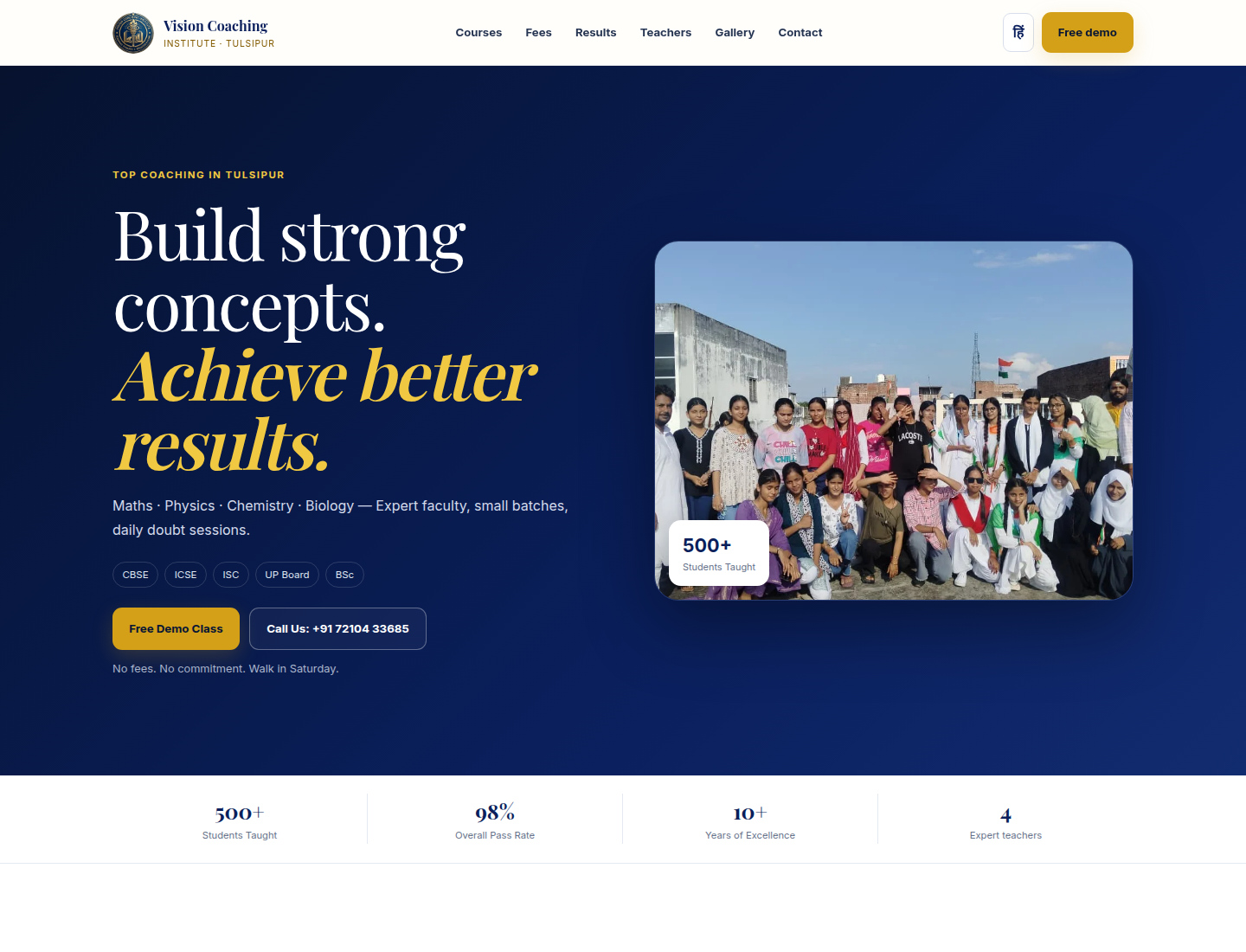
The public site organizes programmes, fees, faculty, results, gallery content and enquiry actions around the questions parents and students naturally ask.
Flagship education project
A live education website with parent-facing content, enquiry journeys, local-search foundations, protected administration and a private Android admin experience.
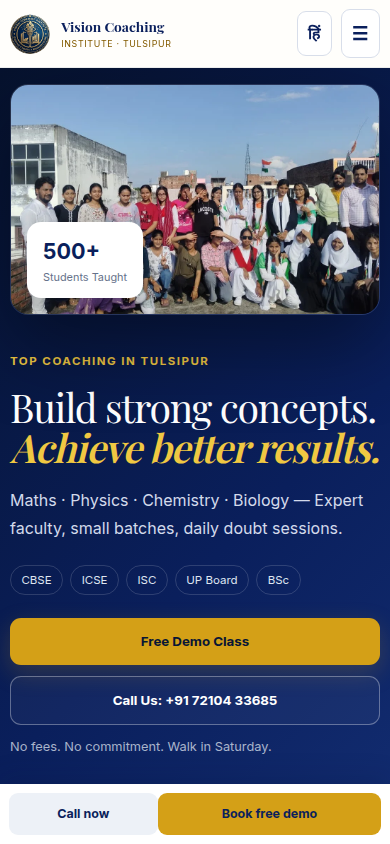
Public screenshots on this page were captured from the live Vision website for this case study. Mutable client facts are intentionally not used as portfolio performance claims.
What the project needed to accomplish
This is deliberately a goals → implementation → operation story. I do not have a trustworthy historical “before” state, so I will not manufacture one.
Create a credible education-focused public presence.
Make important programme and proof information easy to evaluate.
Provide low-friction enquiry paths.
Build a standards-aligned local-search foundation.
Give authorized staff practical control over changing content.
Keep publishing, testing and deployment maintainable after launch.
Public experience
The value is not the number of pages. It is whether important proof, programme information and the next action are understandable on the device the visitor is already using.
How the system works
For an institution that changes programmes, staff, results, batches or media, maintainability and publishing control matter after the launch-day design is finished.
The public site organizes programmes, fees, faculty, results, gallery content and enquiry actions around the questions parents and students naturally ask.
Local-intent pages, canonical metadata, sitemap controls and eligible structured data create a transparent technical foundation without pretending rankings are guaranteed.
Protected web administration and a private Android administration client provide practical content control when update frequency makes self-service valuable.
Schema validation, atomic writes and stale-editor conflict protection reduce avoidable publishing conflicts and preserve a more disciplined editing workflow.
Verified capability map
Each capability below maps to the portfolio claim ledger. The wording describes implementation evidence, not unmeasured business outcomes.
Courses, fees, faculty, results, gallery and contact journeys are organized around the information parents look for.
Crawlable local-intent pages, canonical metadata, sitemap and eligible structured data are implemented without ranking promises.
Authorized content changes can be managed through the web administration system and a private Android administration client.
Schema validation, atomic writes and stale-editor conflict protection reduce accidental publishing conflicts.
Automated checks, deployment verification and versioned backup capability are part of the engineering approach.
Owner control
Vision demonstrates a centralized administration model rather than two independent content systems. Routine website content can stay managed in one place while authorized staff choose the practical device for the job.
Authenticated administration, origin checks, noindex controls and structured publishing are part of the verified implementation.
The Android client connects to the live web administration experience. It is described as private administration tooling — not as a public Play Store product.
After the page design
Central schema validation, atomic saves and stale-edit rejection reduce avoidable publishing conflicts.
Versioned Git-backed content backup can be used where the production setup calls for it.
The project includes automated testing and deployment-health verification rather than relying only on visual inspection.
Typecheck, tests, build, restart and post-deploy asset verification are part of the documented delivery workflow.
Evidence boundary
This case study demonstrates implementation and operating capability. It does not claim unmeasured traffic, ranking, enquiry, admission or revenue improvements.
It also does not turn changing Vision contact details, fees, timings or other mutable business information into portfolio proof. Those facts belong to the client’s current website, not to an engineering success claim.
For your institution
Start with a focused audit of the current site, enquiry journey, search foundation and update workflow.